
Network of objects
Unified management of a network of parking facilities
Each parking lot's local loop continues to collect states and execute allowed scenarios, while the central interface gives the management company a comparable view across the entire network.
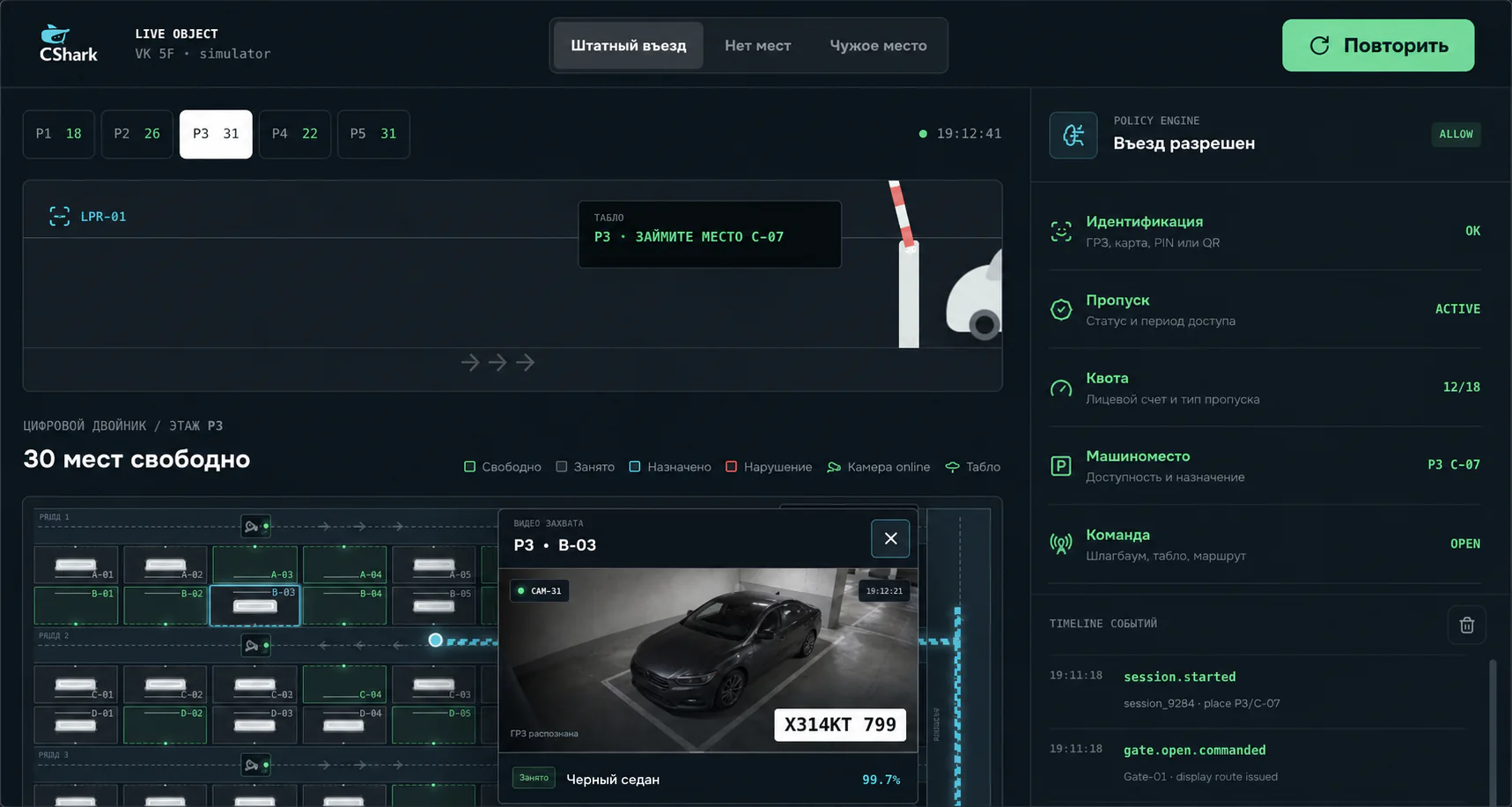
Network of shopping centers, office buildings, airport terminals or residential complexes
Local operator, central dispatch, management, technical support
CShark complexes at sites, central loop, secure communication channels, reporting module
Status of places, events, equipment, loading, duration of parking, roles and tasks
Object task
What the scenario should provide
- Compare objects using uniform indicators without losing the detail of each parking space.
- Divide responsibility between local teams and the central control room.
- Preserve the functionality of object navigation when the external channel is temporarily unavailable.
Sequence
How CShark works
Single model
Each object is described by levels, zones, places, passages and devices with their own geometry and regulations.
Collection of states
The local contour forms an up-to-date map of places and events. The central layer receives consistent data and synchronization status.
Task distribution
Events are first received by the responsible site team and then escalated to a central hub based on category and response time.
Analytics
The reporting module compares load, parking duration, driveway traffic, equipment availability, and event processing speed.
Change management
Rules are published for selected objects and versions. Each change has an author, date and scope.
Interfaces
What does each role see?
Local operator
Works only with its own object and maintains quick access to events of a specific level and location.
Central Center
Sees the entire network, critical exceptions and the load of local commands.
Head
Receives comparable reports and can drill down from a network metric to a specific location and event.
Exceptions
How deviations are processed
External channel not available
The object continues normal local operation, accumulates events and synchronizes them after communication is restored.
Object rules vary
Each parking lot uses its own regulation profile, and overall indicators are based on agreed upon definitions.
Critical event not accepted
After a set time, the task is automatically transferred to the next responsible role.
Result
What the facility gains
- The network is visible as a single system, but each object retains its own geometry, roles and rules.
- The manager can move from the general indicator to the actual location, event and device.
- Navigation and basic object scenarios do not depend on the constant availability of the central channel.
Project CShark